



The Region
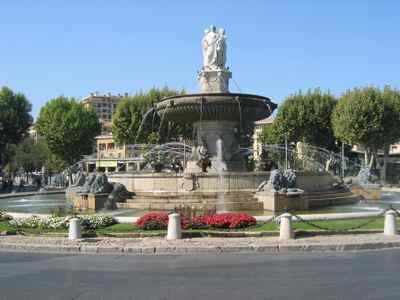 Aix-en-Provence
is not only a town of water and a town of art, but is also a town of
history and culture. It has been a town of water since it was
founded on a site rich in thermal springs by the Romans, 2200 years
ago.
It boasts more than 50 fountains. This town of art
hosts an
opera festival dedicated to Mozart and is the birthplace of
Paul
Cézanne. The monuments found in this town of history bear
witness to all the eras since ancient times up until today. There are
dozens of private town houses from the 17th and 18th centuries that you
will discover while strolling the pedistrian streets. Aix-en-Provence
is
steeped in provençale culture with its markets, boutiques,
shaded
squares, and cafés.
Aix-en-Provence
is not only a town of water and a town of art, but is also a town of
history and culture. It has been a town of water since it was
founded on a site rich in thermal springs by the Romans, 2200 years
ago.
It boasts more than 50 fountains. This town of art
hosts an
opera festival dedicated to Mozart and is the birthplace of
Paul
Cézanne. The monuments found in this town of history bear
witness to all the eras since ancient times up until today. There are
dozens of private town houses from the 17th and 18th centuries that you
will discover while strolling the pedistrian streets. Aix-en-Provence
is
steeped in provençale culture with its markets, boutiques,
shaded
squares, and cafés.
Aix-en-Provence 1 Aix-en Provence 2 Festival d'Aix-en-Provence
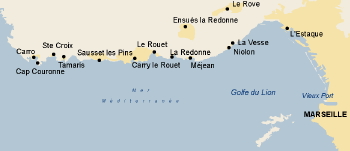
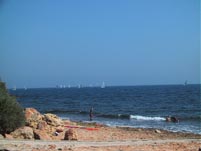
La Côte Bleue (The Blue Coast) includes
about 40km of
Mediterranean coastline between Marseille and Martigues. Less exposed
to tourism than the French Riviera (la Côte d'Azur), La
Côte Bleue preserves a wild character where magnificent
cliffs meet the beautiful sea. A train (SNCF) connects the several
quaint seaside villages that line the coast.
More
about
La Côte Bleue
The Camargue was
formed by the
delta of the Rhône River. It consists of 360.000 acres of
wetlands, pastures, dunes, and salt flats. The region hosts a unique
collection
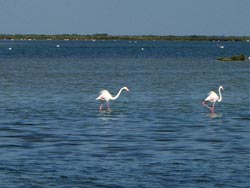
of flora and fauna including pink flamingoes and ibises. The
pastures provide grazing for sheep, bulls, and white horses which are
ridden by the "gardians" (cowboys) who traditionally lived in thatched
huts and still play a part in keeping the Camargue traditions
alive.
The Alpilles -
This
chain of limestone hills running east-west is where bauxite was first
discovered (named after the village of Baux-de-Provence). The Alpilles
are an extension of the Luberon mountains, which stretch out to the
east. 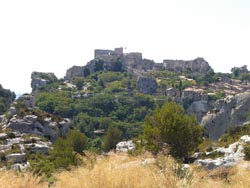 Although
the ridge along the top
seems white and barren, the
Alpilles have been rich in almonds, apricot, olives and grain since the
middle ages. The steep slopes were terraced, and the trees and grains
were planted because of their adaptability to the arid conditions.
Although
the ridge along the top
seems white and barren, the
Alpilles have been rich in almonds, apricot, olives and grain since the
middle ages. The steep slopes were terraced, and the trees and grains
were planted because of their adaptability to the arid conditions.
Windmills were constructed
along the higher part of the hills,
to catch the mistral to power the grinding of grain to flour. A few of
the old windmills can still be seen.
More
about
the
Alpilles
The Luberon is
a beautiful region for 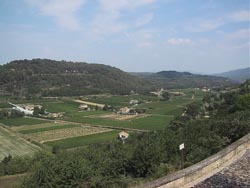 visiting, by car, foot,
bicycle or horse. The mountains and forests are beautiful. There are
scores of lovely, ancient villages, many with castles, forts, ruins,
towers, and other geographical and historical sites.
visiting, by car, foot,
bicycle or horse. The mountains and forests are beautiful. There are
scores of lovely, ancient villages, many with castles, forts, ruins,
towers, and other geographical and historical sites.
Other possible sites: